
User Tools
Sidebar
4dn:phase2:scientific_webinar
This is an old revision of the document!
Table of Contents
Scientific Webinar
4DN Google Drive folder: https://drive.google.com/drive/folders/1Q1mzBETKDLLnMviloMVGCieBNNqKbP36?usp=sharing
Scientific Webinar Calendar: click here to add all the Scientific Webinar events to your personal calendar
Scientific Webinar Assignments (2021-2024): docs.google.com/spreadsheets/d/122eouLgJtMoCJNKmNhygufdU1qqEy-dDomxqqyQ1TxM/edit?usp=sharing
Mission
The 4DN Consortium Scientific Webinar Series is designed to promote sharing ideas and establishment of new collaborations among the consortium members. It features scientific presentations by 4DN member group. These presentations are focused on new discoveries, and new approaches and are not meant to be high-level summaries of deliverables/objectives of each project as in annual consortium meetings. Each group is strongly encouraged to present unpublished research. The PI of each member group may designate either themselves or members of their group to give the presentation.
Format and Instructions
The format of this webinar series will consist of hour-long online video conferences. Each Webinar will feature two presentations, with each presentation allocated 20’ of talk time followed by 10’ of discussion. All member groups of 4DN consortium are expected to present once in this round, although some centers may present twice given the size of their grants.
Presentation Assignments
The Webinar organization committee has discussed and come up with a schedule for presentations after February 2021. See the schedule here: Scientific Webinar Assignment 2021-2024.
The schedule is ranked by funded project and the corresponding PI's last name. While the corresponding PI is put in the presentation slot, it is up to the corresponding PI to decide who in their team is to give the talk. It is encouraged that trainees are given the chance to present. If the corresponding PI wants to switch with someone else on the list in a mutual agreement, then she/he has the responsibility to arrange it and let the Webinar organization committee know.
Scientific Webinar Committee: Ana Pombo, Golnaz Vahedi, Sheng Zhong, Ting Wang, Wenbo Li, Sui Huang, Yin Shen, Taekjip Ha
Scientific Webinar Series slides presentations
March 25, 2022
Moderator: Ting Wang
Presenter: Joao Raimundo (Princeton University) - “TBD” (Link to presenter slides)
Presenter: Maria-Elena Torres-Padilla (Institute for Epigenetics and Stem Cells, Helmholtz Center Munich, Germany) - “ Epigenetic mechanisms of cellular plasticity and reprogramming to totipotency” (Link to presenter slides)
4DN Scientific Webinar Series
March 25, 2022
8:00-8:30 am Pacific Time, 20 minutes talk, then 10 minutes Q&A
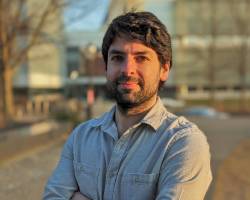
Joao Raimundo
Postdoc
Title: “Topological Operons: Transcriptional Coupling of Distant Regulatory Genes in Living Embryos”
I am a postdoctoral researcher in Mike Levine’s lab at Princeton University studying the role of genome topology on gene regulation and how genome folding contributes to the establishment of long-range enhancer-promoter communication during development. During my PhD I investigated how a subcellular tug-of-war between transcription factors constitutes a molecular switch underlying the asymmetrical shape of the snapdragon flower at Enrico Coen and Manuela Costa’s labs.
8:30-9:00 am Pacific Time, 20 minutes talk, then 10 minutes Q&A

Maria-Elena Torres-Padilla
Professor
torres-padilla@helmholtz-muenchen.de
Title: “Epigenetic mechanisms of cellular plasticity and reprogramming to totipotency”
Maria-Elena studied Biology at the Faculty of Sciences of the UNAM, Mexico and obtained her Ph.D at the Institut Pasteur in Paris. She was a postdoctoral fellow at The Gurdon Institute, University of Cambridge and started her own lab in Strasbourg in 2009. She moved to Munich in 2016, where she is the Director of the Institute of Epigenetics & Stem Cells at Helmholtz Munich and is Professor of Stem Cell Biology at the LMU University. Maria-Elena’s research has been devoted to unravelling the epigenetic mechanisms behind cellular plasticity and cell fate. Her team combines high-resolution microscopy, single-cell and low-input genomic approaches with functional perturbations to study the epigenetic principles underlying cellular reprogramming and the establishment of totipotency in the early mouse embryo.
HOW TO Join the Webinar
The Webinar Series will be on the 4th Friday of each month from 8am-9am Pacific Time, 11am-12pm Eastern Time.
Join Zoom Meeting
https://4dnucleome-org.zoom.us/j/95145522681?pwd=TFN4ZG0xamYwMXpvbnE1Y0dkMFllUT09
Meeting ID: 951 4552 2681
Passcode: 299876
One tap mobile
+16699006833,,95145522681#,,,,*299876# US (San Jose)
+13462487799,,95145522681#,,,,*299876# US (Houston)
Dial by your location
+1 669 900 6833 US (San Jose)
+1 346 248 7799 US (Houston)
+1 253 215 8782 US (Tacoma)
+1 301 715 8592 US (Washington D.C)
+1 312 626 6799 US (Chicago)
+1 929 205 6099 US (New York)
Meeting ID: 951 4552 2681
Passcode: 299876
Find your local number: https://4dnucleome-org.zoom.us/u/aj8w26y0V
During Presentation:
ATTENDEES, PLEASE:
- MUTE YOUR COMPUTER MICROPHONE WHEN JOINING THE WEBINAR
- LET THE MODERATOR KNOW THAT YOU HAVE A QUESTION VIA CHAT
- QUESTIONS WILL BE ADDRESSED AT THE END OF EACH PRESENTATION, DURING THE DISCUSSION PERIODS
Next Scientific Webinar Presentation
When: April 22, 2022
Moderator: Sheng Zhong
Presenters:
- Member from
- *Danwei Huangfu (contact), Effie Apostolou, Christina Leslie's group (Presenter and title will be determined by group) * Member from David Schatz (contact), Siyuan Wang's group ** (Presenter and title will be determined by group)
4dn/phase2/scientific_webinar.1647286802.txt.gz · Last modified: 2025/04/22 16:21 (external edit)